An interview with Dame Sarah Storey

Scot Tares has a chat with the UK’s most successful Paralympian ever: Dame Sarah Storey.
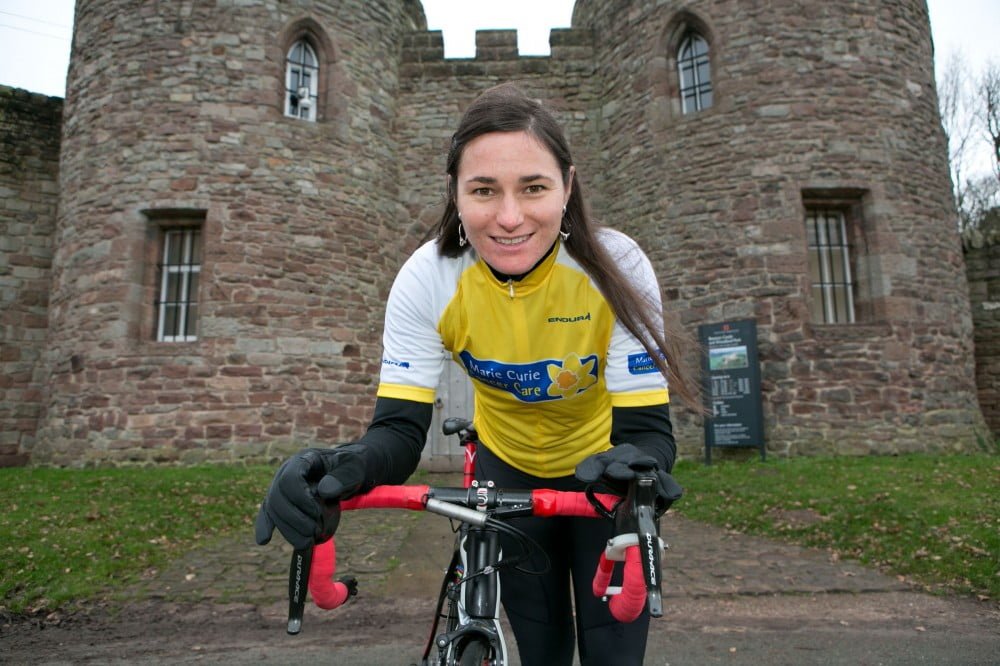
Dame Sarah Storey, wearing a Marie Curie Cancer Care cycling jersey leans on the red handlebars of her bike in front of an old, turreted building.

Dame Sarah Storey had an incredible year in 2012, with many wins in road and track cycling, topped off with four gold medals and a world record at the Paralympics which brought her overall tally to eleven gold, eight silver and three bronze, making her the UK’s most successful Paralympian ever.

This week it was announced that she would be patron of the 2013 Etape Series of events that includes the Etape Caledonia held each May in Pitlochry, Highland Perthshire. Prior to the announcement I caught up with Dame Sarah.

In 2005, Dame Sarah switched from swimming to cycling after a series of ear infections forced her out of the pool and onto the bike. She started cycling to maintain form during her enforced leave of absence from the pool, but was soon offered a trial by British Cycling. This was so successful that she had guaranteed her selection for the European Cycling Championships in Holland. She came home from that event with a world record, two gold medals, a silver and a bronze. Despite this, the decision to focus on cycling rather than swimming was not an easy one but, following advice from her coaches, the transition was made and she hasn’t looked back since.

Dame Sarah, unlike many cyclists, does not limit her focus to a sprint or an endurance event. She combines a lot of road racing with a mix of different disciplines on the track, from team sprint and short time trial efforts, to longer, endurance based events such as the individual pursuit. For many riders, the training involved to combine such a mix of disciplines and achieve optimum performance can be difficult, but not so for Sarah Storey.

“It’s all about balance; partly about what nature is giving you, but compensating with training to create what you need for the other events. Being able to sprint while on track gives you speed on the road, and an ability to sustain distance on the road enables you to cope better on the track. We constantly monitor everything that we do and tweak accordingly.”

Dame Sarah has competed in, and won, many non-para cycling events and I was interested to find out whether she felt the integration of para and non-para athletes on the same programme at the same event was something she saw as positive. She commented:

“It’s not logistically possible to fully integrate para and non-para events as the event would be 6-8 weeks long and you’d lose the quality of the riding. We should put para-sport on an equal footing which is what London demonstrated, but to combine (both) you’d potentially lose something; opportunities would be minimised as opposed to maximised. No athletes I know of are calling for integration.”

Since the Commonwealth Games in Manchester in 2002, there has been a move to run para and non-para sport alongside each other in the same games. Glasgow 2014 will see more para-sports than ever, including tandem track cycling for the first time. Dame Sarah continued:

“The Commonwealth Games are a good size of event to be able to do that, but it’s not a comprehensive programme; it’s a step forward but not full integration. Para-sport is too big to integrate fully. We welcome the changes made to integrate, and there may be a time when there is a full para-Commonwealth Games. Hopefully the London legacy will be that more para-sports will be reported upon. Tandem riders are very excited to compete in Glasgow.”

Dame Sarah Storey has raced, and won, many non-para cycling events and just missed out on a place for the Olympic British Cycling team for London 2012. Looking to Glasgow 2014, there are no para-events for her to ride, so she will be looking to gain a place on the English team for the non-para cycling events.

“In Glasgow 2014 the same events will be available to me as in Delhi.” (Dame Sarah came sixth in the non-para 3000 m pursuit.) “I have always competed in available events, alongside able bodied athletes. It’s just another competition. Whatever the level of impairment, the athlete is best to compete in any event, not just para-events. It’s always been done; no-one’s paid any attention before.”

Out of all the excitement and victories in 2012 in both men and women’s racing, many of the women’s events proved to be a lot more exciting to watch than the men’s, dispelling the myth that women’s racing is boring. However, there is still discrimination and prejudice towards women’s cycling as female riders struggle to gain parity with men in sponsorship, media attention and race opportunities.

“It’s a similar situation to para-sports; men started doing it first, women are one step behind. It’s down to the UCI to be able to sell the TV rights. Even though someone might be willing to show the event in its entirety, it’s hard to do so because the investment is not there. The infrastructure is there, the riders are there, it’s just a matter of time. Since the games in London it’s been an incredibly positive response; we shouldn’t be afraid to step into the unknown and let it happen, because it can just happen.”

As Dame Sarah became successful in sport at a young age she found that she was marginalised by her fellow school pupils. Sport can have a hugely positive impact on people’s lives and give them confidence, but often young people involved in sport are viewed as different by their peers. The amount of training involved to become successful can also mean young athletes feel they may not have the social time their friends may have.

“People have to stop seeing sport as something that takes you away from something or that you need to sacrifice something for it. I haven’t sacrificed anything; I’ve done exactly what I wanted to do. We need to redefine what we are saying to our children: redefine what our use of time means; what is leisure time? Hanging around, playing video games, or training in a sport that we love. We need to encourage people to see it as an enhanced life experience.”

So for young people looking to get into sport, what advice would Dame Sarah give?

“Keep looking, keep trying; there are lots of tools on the internet, lots of information out there. Be prepared to look, do your research. Get down to your local sports centre, find out what’s happening and get involved. Try out everything, don’t limit yourself.”

Skinny Tyres logo showing the silhouette of a female cyclist against an abstract background with the words Skinny Tyres in white in the foreground.

Ben Lawers in Highland Perthshire

Wherever he cycles in the world, Scot Tares finds that Highland Perthshire in Scotland is hard to beat.

ScotlandAs I rode, numbers raced through my head: four miles to go to the top; my average speed was 12 miles per hour, giving an ascent time of approximately 20 minutes; my pedal cadence was 80 revolutions per minute, giving 1600 pedal strokes needed to get to the road summit;  my heart was beating at 155 beats per minute, not in the red, but close to it, and it would beat another 3100 times before levelling out as I rode over Ben Lawers.
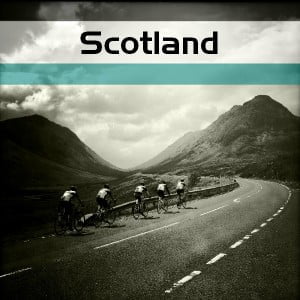
I was cycling on one of my favourite climbs in Highland Perthshire, if not the UK. It has many qualities of an Alpine ascent, from the moment it breaks from the steep initial ramp through the trees to the panoramic vista that opens out before you as you climb higher above Loch Tay; and for me, that is one of the key points that sets it above its giant Alpine cousins.

Where the Alps offer longer ascents, the lack of distance on Scottish climbs, such as Ben Lawers is more than made up for by the view. In the Alps, the wider view is often blocked by a towering mountain in front of you and although the setting is often spectacular, I would rather have a grand view to take my mind off the numbers racing through my head.

And so it was with Ben Lawers: as I broke out through the trees, my mind instantly forgot the computer on my handlebars that spewed out a list of figures that served only as a reminder of the pain ahead and instead filled with the pleasure of riding my bike in one of the best cycling countries in the world; our very own. Wherever I have cycled in the world, on my return I have ridden through Breadalbane and Glen Lyon and over the shoulder of Ben Lawers and been reminded what it is that makes cycling in Scotland so great and wonder why I would want to ride anywhere else.

Scot Tares

Twitter: @SkinnyTyres

Where to ride

Ben Lawers: The ascent over Ben Lawers, the tenth highest mountain in the UK, is just one of the many highlights of this classic circular route.

Map

OS Landranger 1:50000 51

Grid ref

Start – NN741 470 (Fortingall)

Details

31 miles


1693 ft of ascent

Ben Lawers climb: 4 miles

Description

Starting at Fortingall head south towards Fearnan, before turning onto the A827 south west. After 11 miles, turn right onto the climb of Ben Lawers, which initially climbs through trees, but breaks out onto an Alpine style mountainside. The climb starts to level out as you approach Lochan na Lairige, but then kicks up steeply one last time to take you to the top of the dam. A long winding descent on single track road takes you into Glen Lyon; care is required for this descent. If required you can stop for refreshments at the bike friendly café at Bridge of Balgie, before riding back via Glen Lyon. The Glen is perhaps one of the highlights of this route as it is slightly downhill and if you have a tail-wind then you are in for a treat as you ride through the historic steep-sided ‘longest, lovliest and loneliest’ glen in the country.
Skinny Tyres logo showing the silhouette of a female cyclist against an abstract background with the words Skinny Tyres in white in the foreground.

Obree the Maverick

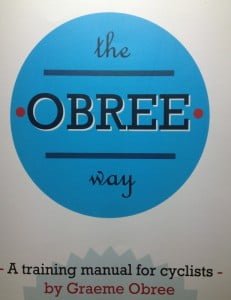
The Obree Waya training manual for cyclists.

Graeme Obree offers a unique approach to cycle training

Unfortunately, to some of the more rigid-minded individuals he has come up against during his career, his unwillingness to conform to contemporary wisdom has meant that he has had a bumpier ride than he may have liked, but this is perhaps what Obree thrives upon and is the spark that drives his passion for the sport of cycling. His approach is direct and outspoken; he knows what he wants and he knows how to achieve it and it is this single-minded determination and confidence in his methods that shines through in his new book The Obree Way.

This is a beautifully packaged training manual like no other; you won’t find the scientific references to leading research in performance training, but you will find it packed with meticulous details on what has worked for Graeme, (and who are we to question a World Champion?), and perhaps this is the book’s greatest strength. In the introduction Obree states, “… it would become habit for me to question every aspect of bike set-up, riding technique, positioning, nutrition, and training” and his enthusiasm to probe into contemporary best-practice, pull it apart and piece it back together in a more effective approach, leads the reader to question their own approach to cycling.

Obree himself states that, “you may not find every piece of advice in the book useful …”, but that isn’t really the point of this book; it is really more to enlighten those who have been drowned in an ocean of facts, figures and, more often than not, the commercially driven opinion that clouds the real questions that a cyclist wants answered. It provides a starting point where each cyclist can begin their own journey into the world of cycling, or rediscover and reignite a passion for training that may have been in the doldrums.

Each of the thirteen chapters focuses on a specific area of training and preparation that Obree feels is relevant. These include: bike set-up, pedalling, stretching, psychology and nutrition and diet. It is not exhaustive, but all the key points are there. Be warned though, if you are looking for a book packed with training plans, this is not it; what Obree has succeeded in doing is producing a book that is quite different to most others on the market in that it provides an armoury of techniques and, more importantly, a mind-set or way of thinking that many other publications brush over with, at best, a passing glance. 

One of the chapters that jumped out and struck a chord with me was, The Turbo Session. It is in this chapter that Obree’s unique character shines through. As with the rest of the book, there is no list of workouts here to spoon-feed you a training programme, (to have included these, the book would be treading ground well ridden over already and that is not Obree’s style); instead, Obree puts a passionate slant on how to get the most out of your turbo trainer.

His approach of getting the environment right, correct visualisation and thinking of the rhythm of pedalling gave such a new perspective to my indoor trainer-shy attitude, that I found myself dusting the cobwebs off my own turbo (previously regarded as a torture implement from the Spanish Inquisition) and, enjoying might be too strong a word for now, but certainly not hating the training session.

Other chapters, such as Breathing, shed new light on often forgotten about, but crucial facets of getting the most out of your performance in a way that makes you question why you had never thought about it before. The simplicity of the subjects in this book betrays the depth of knowledge conveyed in each chapter and you find yourself thinking about the words long after the book has been returned to the shelf. It’s back-to-basics, but delivered in a way that is engaging and pushes the boundaries, all in the pursuit of improvement.

In a generation where the head honcho of British Cycling has almost ingrained the mantra of marginal gains in the psyche of coaches and riders alike, it seems that Graeme Obree has been practicing this himself for years and is now ready to share his secrets.

Throughout the manual, Obree offers a way of thinking and getting into a mind-set that is supplemented with technique and outcome that is partly a document of Obree and his own road of discovery, partly martial philosophy for two-wheels and partly a manual for the discerning cyclist who likes to think out of the box a little.

The Obree Way – a training Manual for Cyclists by Graeme Obree 

ISBN 9781408196427 Bloomsbury

Scot Tares

Skinny Tyres logo showing the silhouette of a female cyclist against an abstract background with the words Skinny Tyres in white in the foreground.

The anatomy of cycling

The anatomy of cycling

Hands up if you think cycling is all about leg strength. If you do, go to the back of the class.

This is a common misconception among many riders, and can be dangerous as a primary focus on leg strength can cause an imbalance in the body, which leads to injury. In fact, core and upper body strength in cycling can be looked upon as the inverted foundation that supports the power you push through your legs. A lack of core and upper body strength can lead to injury and discomfort when riding your bike, especially when climbing, but even if you don’t experience any pain, improving your flexibility and upper body strength will pay dividends in your riding ability and speed.

Core strength and stability can be increased by movements such as the scissors.

Cyclists are notoriously bad at stretching, and when you think of the repetitive pedalling and fixed, hunched position that is maintained on a bike, sometimes for hours at a time, it can be a recipe for disaster. However a new book entitled, ‘Anatomy of Cycling, a cyclist’s guide to strength, flexibility and conditioning’ by Jennifer Laurita, aims to address these issues and allow riders to train in a more holistic way.

Improve spinal and pelvic stability with a bridge and leg lift.

The book is split into five main sections that focus on flexibility, legs and arms, core strength and stability, balance and posture and, finally, workouts. Each section devotes two pages to each movement and is clearly illustrated and explained. The format follows a step by step explanation of the exercise, supported by photographs accompanied by larger anatomical illustrations detailing the muscles targeted by the exercise.

Side notes also detail the benefits, things to think about and things to beware of when doing the exercise. It’s beautifully illustrated and is clear and concise enough for even the most novice of riders, but also has sufficient depth for more experienced cyclists to delve deeper and explore how to get the most from each exercise and apply it to their riding.

Improve your core stability with the dead bug.

It is this clear and uncluttered format of the book that ranks it above others with a similar theme but for me the winning point is that all the exercises contained within its cover can be completed with simple equipment. Too often, these books require access to a gym or expensive equipment. For the average and often time-crunched cyclist, this luxury usually isn’t an option. To complete each of the 66 stretches or exercises in the book you only require access to a chair, a bosu balance trainer, a medicine ball, a swiss gym ball and a foam roller; all of which are inexpensive and easy to store, providing you with your own home gym.

Scot Tares

Anatomy of Cycling by Jennifer Laurita

Published by Bloomsbury www.Blomsbury.com

ISBN 978-1-4081-8769-2

Paperback – 160 pages


Skinny Tyres logo showing the silhouette of a female cyclist against an abstract background with the words Skinny Tyres in white in the foreground.

Cycling the same old roads

Even after years of cycling the same roads, some rides can still be a voyage of discovery.

Everyone who cycles builds up a repertoire of their favourite routes, and over time these rides become so familiar that you become aware of all the peculiarities and features of that route. Among a group of my friends we are able to describe a route by mentioning these features rather than naming the road or trail.

One particular favourite is the welly gate on Craigie Barns, so called because of a welly that had been stuck upside on a fence post beside it. It was there for years and although it has now disappeared, we still refer to the welly gate and everyone knows exactly where it is. You might think that all this knowledge meant that there weren’t many places I hadn’t ridden, but more often than you would think, I come across a road or a trail that I have never pedalled along. It’s a strange feeling to be riding through an area that is so familiar, but unrecognisable at the same time.

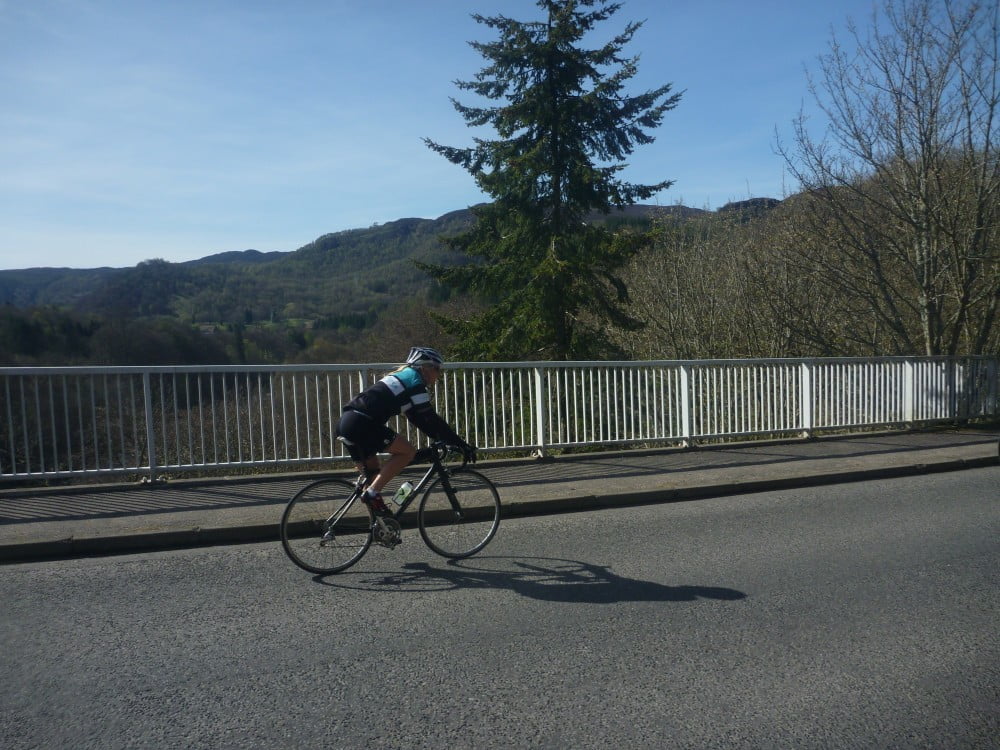
Cyclist riding over Garry Bridge on the Etape Caledonia route

This happened to me recently as I pedalled out on my regular Saturday morning dog ride around Craig Vinnean (my two dogs exercise a lot, so my only way of keeping up with them at times is to take my bike). Despite the previous weeks being mild, sunny and warm I was surprised to find that the upper tracks were still deep under snow. Not being one for turning back I ploughed on, before shortly having to shoulder my bike to make any progress in the deep and soft snow.

My thighs burned as I stepped on the snow, which held my weight for a micro-second before giving way. I made slow progress in this fashion for 45 minutes, before I came across a side trail that I had never noticed before. I had no idea where it would lead, but I surmised that it couldn’t be any worse than this current purgatory I was putting myself through.

Much to my delight I found the trail headed deep into the trees and was completely clear of snow. 15 minutes later I emerged out on the main track again, much lower and now thankfully clear of snow. Looking back the trail from which I had just emerged was obvious and despite my familiarity of the forest I was surprised I had never spotted it before. When you riding cycle through such roads its better to choose the best mountain bike for you to make your journey safer and smooth

It is one of the joys of cycling that rides and routes can become old friends, but still have the temerity to throw up some surprises for you to explore now and then.

Get out and ride.

Scot Tares

Where to ride.

Cycling in Angus: Montrose Basin

Where to ride: Montrose Basin
Location:OS Landranger 1:50,000 Map 54

Distance 12 m/ 20km

Start at Mains of Dun Car Park NO 669591

Details:An on road route around the nature reserve of Montrose Basin, with great views of the basin as you ride and plenty of places to visit on the way including the Scottish Wildlife Visitor Centre and Bird Observation Point at Montrose Basin, and Mains of Dun Farm with its mill remains.

From Mains of Dun head south to join the A934, then A92 through Montrose before turning left onto the A935 to take you back to Mains of Dun.

Skinny Tyres logo showing the silhouette of a female cyclist against an abstract background with the words Skinny Tyres in white in the foreground.

Youth cycle racing

If you want to get your kids to eat their greens, enter them in a bike race.

The Commissaire stood with his starting pistol in the air, “The race will start within the next 15 seconds”, he shouted to the riders who sat on their bikes with a look of absolute concentration on their faces. Bang! The starting pistol fired and the riders sprinted to get into the sharp left corner first.

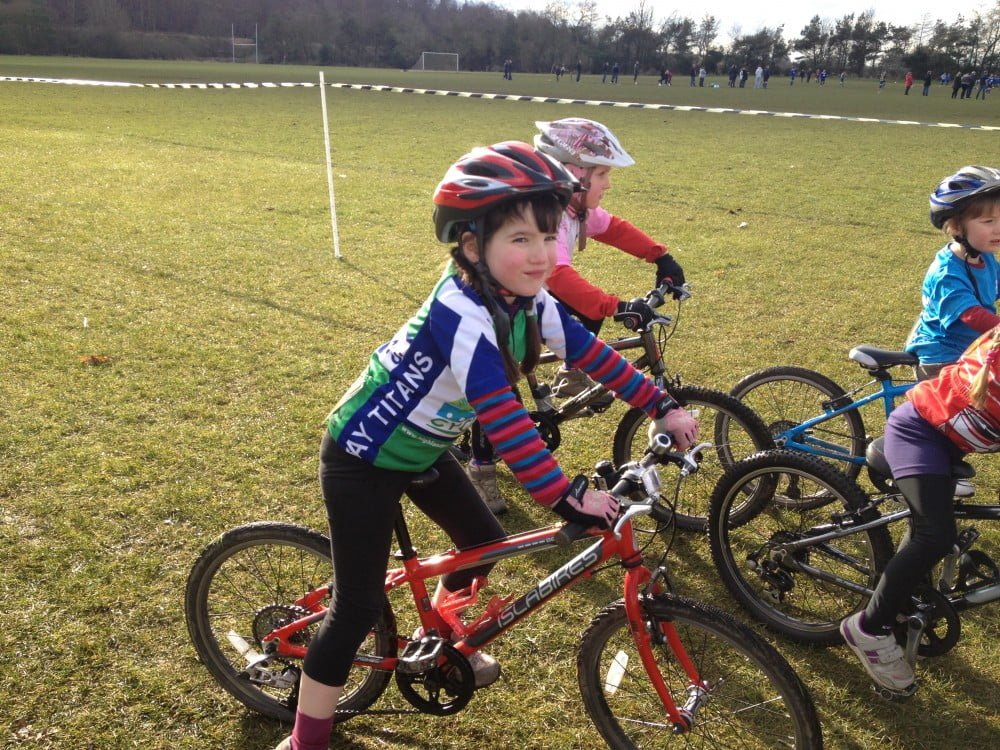
This could have been a scene from a professional race, but it wasn’t; each of the 20 riders lined up on the starting grid were six years old or younger and they were all taking part in the West Lothian Clarion Youth Cyclo-Cross race in Linlithgow last Sunday.

Such events happen up and down the country throughout the year and are a great opportunity for young riders to experience the thrill of racing, but more importantly, it is a chance for them to get out and have fun on their bikes with lots of other young people.

My own two children were taking part in this race; my six year old girl was a veteran at such events, having entered several before, but for my four year old boy it was his first and such was his excitement that he went to bed early every night in the lead up to the race and was asking for more vegetables for his tea, “Just to be strong and healthy for the race, just like Chris Hoy,” he said. It was a parent’s dream and our only wish was that there was a race every week we could enter him in.

At the end of the race there were a lot of red cheeked and sweaty little faces, but every one of them had a grin from ear to ear as they tucked into the cake and hot chocolate from the refreshments tent. As we drove home in the car and my little boy’s eyelids grew heavier he muttered, “Can we do this again tomorrow?”.

The cyclo-cross season is coming to an end, but the Scottish Cross Country (SXC) mountain-bike series is about to start with the first event being held in Forfar on Sunday 17th March 2013. SXC is similar to cyclo-cross in that it is an off-road event with categories open to all age groups of riders, allowing parents and their children to enter for the event.

If you would like more information then visit: Scottish XC.

Where to ride?

The Trossachs for some off-road riding

Where to ride: The Trossachs
Location:OS Landranger 1:50,000 Map 57 Distance 13 m/ 22km  one way Start at Aberfoyle NN 523011 Finish at Callendar NN 626075
Details:This on and off-road route through the Queen Elizabeth and Achray Forests leads you over the Dukes Pass and down to Loch Venacher and onto Callendar. It is suitable for adults and older children and follows traffic-free forest tracks, some minor roads with a short section of main road at Aberfoyle. The start of the ride has a stiff climb, but then it is steady going after that and mostly downhill


Skinny Tyres logo showing the silhouette of a female cyclist against an abstract background with the words Skinny Tyres in white in the foreground.

Castelli Fusione Windstopper jacket

Let the Castelli Scorpion take the sting out of your winter ride. I have a certain nostalgic tendency towards cycling and my preference is always for Italian. It’s not just a romantic notion though, as the Italians have a passion not just to produce the best, but to do it in the most stylish way possible. For this very reason I have long been a fan of Castelli. In this respect the Castelli Fusione Windstopper jacket does not disappoint; clearly a lot of time has been taken to ensure it looks good, but no matter how stylish something looks, it is the functionality that counts on the day.

Racing fit and sleek lines

The cut of the jacket is good and lends itself to the racing heritage of Castelli with sleek lines and a fit that avoids material flapping in the wind. I have long arms and I was pleased to see that with my arms stretched out on the hoods of the bars my wrists were still covered. Weighing in at 294g the jacket is more of a bantam than flyweight, but it’s certainly no heavyweight. The slight weight increase offers more protection from the elements, but is on the cusp of having too much bulk to pack into a jersey pocket; it does, but only just.

However, that is not really an issue as the Fusione is more of a jacket to be used on days when the weather is such that wearing a jacket from start to finish is the order of the day, keeping your lighter and thinner, packable jackets for less inclement conditions.

The worst of the Scottish winter weather

It was Christmas Eve and the forecast for my northerly bit of the UK was horrendous: gales blowing at 60mph with gusts of 80mph; driving frozen rain with snow at higher levels; not the ideal riding weather, but I had signed up for the Rapha Festive 500 and nothing was going to stop me heading out.

I donned my Castelli Fusione Windstopper jacket, flicked up the collar and got my head down. The first few miles were directly into the headwind and progress was slow, but I was warm. My Windstopper jacket was doing its job well so far. I’ve tried various active shell jackets before, with varying degrees of success, but for this kind of weather I would usually wear a heavier weight jacket and several layers, with the inevitable Michelin Man feeling the result.

There is nothing worse than feeling overly bulky as you head out on your ride, so the close fit of the Fusione combined with its weather beating qualities was a delight. Underneath I wore a long sleeve club training top and underneath that a long sleeve merino base-layer and that was more than enough to keep me warm. Indeed if the mercury level had been a few degrees higher I may have been too warm, but the Fusione had that under control with front and back zipped vents to allow a through-flow of air.

As I rode on, conditions deteriorated; rumbles of thunder emanated from the hills above me and the sky grew very black indeed and it felt like I was riding into the depths of Mordor from Lord of the Rings.

My average speed was pitiful as I fought against the rising wind speed which was now carrying flakes of snow past me at a high rate of knots. Mixed in with the snow, hail and frozen rain needled my cheeks, but the high-backed collar of the Fusione, with its soft fleece like material, kept the sting from the back of my neck. The descents were where the Helium Windstopper fabric really showed its capabilies  stopping the chill dead and keeping me warm and comfortable.

Castelli Cycle clothing

My white jacket was highly visible out on the road in the dark and dingy conditions and the reflective details across the shoulders, sleeves and on the vent lanyard straps as well as on the distinctive Castelli branding across the chest and classic Castelli Scorpion gave me a confidence that I would stand out to other road users no matter how dark the sky grew.

An elasticated hem kept the chills at bay around the waist and Velcro adjusters at the sleeve cuffs ensured a snug closure at my wrists. The seams are stitched rather than taped but, so far, I haven’t experienced any issues with moisture making its way through. Overall, the Helium Windstopper® fabric does its job well and despite the conditions I never once felt a chill. T

The Fusione is water repellent, rather than waterproof, but it did a good job of keeping me dry. Prior to trying out the Fusione I had read some reviews that breathability had been an issue, but I am glad to say that I had no such problems, even without using the sizeable vents.

The zipped vents appear with two on the front and two larger ones on the back. The front vents are fairly standard, but the back vents are notable for the lanyard strap that hooks onto the zip. This allows easy access to the top zip, without having to stretch your arm; this works well on opening the vent but is not so successful when trying to close the vent again.

A bottom zip also allows opening of the vent and access to rear pockets in your jersey underneath. There are no pockets on the Fusione, which I wouldn’t really expect on a race-cape and the inclusion of them would have added bulk and taken away from the sleek lines of this jacket and added little functionality.

Overall I have been impressed with the Castelli Fusione Windstopper Jacket, both for its notable Italian style and flair, but more-so for its remarkable ability to shrug off the worst that the Scottish winter weather could throw at it. I’ve ridden over 300km wearing it in the grottiest conditions and it is still looking new and doing it’s job well.

Castelli – an Italian cycling legacy

Italian cycle clothing manufacturer Castelli has a long and rich history of supplying clothing to generations of professional riders such as Italian legends Fausto Coppi and Gino Bartali. The brand as we know it today however started in 1974 with Maurizio Castelli and it was at this point that the innovation really kicked in as the company started to produce a series of firsts for cycling kit, including the first aerodynamic lycra shorts and first functional thermal winter cycle clothing.

Professional riders like Eddy Merckx, himself someone who was always looking for the cutting edge to gain advantage on his rivals, gave the company a huge boost by wearing a Castelli body-suit on his successful World Hour Record ride. Perhaps one of the most important innovations by Castelli, however, was the pioneering of the sublimation dye process that allowed colours and logos to be added to technical fabrics; from that point on, cycling’s commercial aspect would never be the same again.

Sadly Maurizio Castelli died in 1995 from a heart-attack, at the age of 47 whilst cycling up the Cipressa, a climb made famous by its inclusion in the one-day Queen of Cycling Classics Milan San Remo. Castelli’s legacy lives on however in the brand that bears his name and his design flair and innovative approach to cycling kit continue to be evident in the range of items that the company produce.

Scot Tares

Skinny Tyres logo showing the silhouette of a female cyclist against an abstract background with the words Skinny Tyres in white in the foreground.

Improve your pedalling

Get more out of your cycling: improve your pedalling with a more efficient pedal stroke.

You’ve spent a lot of money on your bike and invested countless hours in all weathers to get fitter and faster on your bike, but if your pedal technique is inefficient, then you are expending a lot more energy and effort than you need to.

Swimmers spend a lot of time in the pool, not just improving their fitness, but also honing their technique. Combined, technique and fitness will contribute to a better and more efficient swimmer. It is something that cyclists can learn from; we invariably spend a lot of time putting in the miles to become stronger and faster, but rarely focus on our technique.

The French term, souplesse, is often used to refer to someone who has a supple and flowing pedal cadence. A smooth pedal stroke like this can make the rider look like they are riding effortlessly, whereas a rider that is mashing at the pedals, not only looks like they are making hard work of it, they are also expending a lot of extra effort for very little return.

There are four key points that you need to focus on when improving your pedal technique:

  • Cadence – the faster you can pedal in an easier gear, then the further you go for less energy expenditure.
  • Engage your glutes – your glutes are huge powerful muscles, but riders often just rely on their quads to keep their momentum going. Get your position right on the bike. Get you saddle height right, ensure the fore and aft position is correct and get your body position right for the terrain you are riding.
  • Pedal in a circle – it sounds obvious, but most riders have dead spots in their pedal stroke because they only engage with the pedal at the top of the pedal stroke. Pushing the pedal over will pay massive dividends. This can only be achieved by engaging your glutes.
  • Relax – all of the points above can cause a rider to tense up and hunch their shoulders. This can lead to aches and pains and will prevent you from maintaining a smooth and high cadence.

Just like a swimmer, a cyclist needs to practice on each of these aspects to improve their technique. It is not just a case of thinking, “Right, I know what I need to do, now let’s go and do it”. Each technique needs to be practiced over and over again with a conscious and reflective learning style. Only when you have mastered each technique can you pull them all together and master an efficient pedal technique.

For more information on pedal technique or any other aspect of skills or performance coaching, get in touch or join us on one of our coaching weekends.

Skinny Tyres logo showing the silhouette of a female cyclist against an abstract background with the words Skinny Tyres in white in the foreground.

The biley-up and drum-up

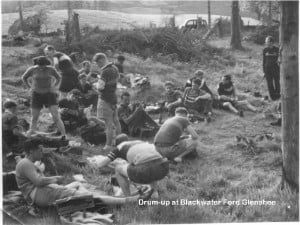
Drum up at Blackwater ford Glenn Shee mid 1950s

Scot Tares tells us of the old-days when a cup of tea was enough to let you cycle 280 miles in one day.

There used to be a time when the biley-up was a key part of cycling club tradition. The impromptu stop to brew up a pot of water for a cup of tea often happened several times during a ride and clubs and riders had their favourite spots to stop at for a brew.

The last biley-up that I was at was on the banks of the Tay by Dunkeld as part of the Perth United CC Christmas ride. Being Christmas it was not polite to just brew up a pot of tea and more often than not a wee tipple and a few sausages cooked over an open fire were part of the deal. That year I ended up in the bad books as my old shaggy lurcher, who I had taken along spotted, a string of sausages in a saddle pack and he was off with them quicker than a bunch of cyclists in cleated shoes could chase.

Nowadays the café stop is an integral part of cycling club life, but preceding that was the biley-up. William Mclennan, who rode for Charles Star CC in Dundee and was a key figure in the Dundee Centre representing all the Tayside clubs, told me of a ride report he read in the Forfarshire RC club book that detailed an impromptu ride in 1964.

“Members left the gates at 12.30am on Sunday morning…” it began and then went on to describe a ride of over 280 miles taking in Lochearnhead, Glen Ogle, Crianlarich, Glen Falloch and Stirling. By the time they got to Glen Devon for their second boil-up of the day they were starting to tire, “The run from Glen Devon was ‘pure hell’ with the sun, sore legs and sleepiness taking their toll. A good time was had by all … or so they said”.

It proves the masochistic nature of cyclists and as I sit here and type I’m thinking to myself, “that does sound like fun and I know I’ve still got the old biley-up kettle in the shed somewhere.”

Get out and ride.

Scot Tares

Cycle route

Cycling in Glen Devon and Glen Eagles

Where to ride: Dunning – Glen Devon – Glen Eagles
Location:OS Landranger 1:50,000 Map 58Start/ Finish – Dunning: NO 019145
Details:25 miles/ 40 km road rideFrom Dunning ride up the Common of Dunning (B934) for 3 miles of ascent before descending back down to the Yetts o’ Muckhart. Just before you reach the Yetts, turn right into Glen Devon on the A823 and follow this road through Glen Eagles and onto Auchterarder. Follow the A824 through Auchterarder before turning right onto the B8062 back to Dunning.
Skinny Tyres logo showing the silhouette of a female cyclist against an abstract background with the words Skinny Tyres in white in the foreground.

Cycling clubs

Scot Tares finds cycling can be fun if you club together.

Last week I was sent a couple of photographs from a Courier reader who cycled with my Dad in the 1950s in the now defunct Charles Star CC. The two photos, one of a club ride up to Reekie Linn and the other a group shot of the whole club were fantastic to see and it struck me how similar they are to photos I have of myself out on club rides. The steel bikes and woollen clothing have been replaced by carbon fibre and lycra, but the spirit of camaraderie is still there and for me that is what joining a cycling club is all about.

When I joined my first cycling club, I followed in my Dad’s footsteps and became a member of The Star. I still have my 1980s red, white and black diagonal stripe club jersey; perhaps it was the influence of my Dad, but I couldn’t imagine cycling without being part of a club.

Despite the demise of Charles Star CC, there are more cycling clubs in Courier country than ever before and they are attracting new members all the time. However there is a wave of cyclists coming through for whom joining a club is not a consideration. Those I have spoken to have heard of, or witnessed instances of clubs being too cliquey or elitist. This may be the case in a minority of clubs, but my experience has always been entirely positive.

The benefits of joining a club are numerous, such as: meeting like-minded individuals, building a wide network of riders to call on when you want to go out for a ride with others and probably most valuable, learning a lot of new things about riding your bike, which by yourself could take years of trial and error.

Over the years I’ve made a lot of really good friends and had many adventures from being part of a cycling club and I would urge anyone who isn’t in a club to give it a go. Do a bit of research and find that the club that most suits you and if it turns out it wasn’t for you, then you’ve not lost anything, but you never know, it may just open a door to a whole new world of riding.

Get out and ride.

Scot Tares

 
You can check out all the cycling clubs in Courier country at British Cycling: http://www.britishcycling.org.uk/clubs
Skinny Tyres logo showing the silhouette of a female cyclist against an abstract background with the words Skinny Tyres in white in the foreground.

Subscribe

Skinny Tyres News