Gadgets on bikes

Taken from the Blazing Saddles Column in the Tayside Courier Weekend Supplement 11.8.12
Turn off, tune out, change gear. Scot Tares advocates a simpler approach to cycling.
“I thought of that while riding my bicycle.” – Albert Einstein (on the theory of relativity)
Bicycles inspire greatness. I’m sure someone great has said that at some point in history and not just in a sporting sense, although in 2012 our competitive British cyclists have pushed the pedals to a point where the momentum of their achievements will propel them and their successors to greatness for years to come.
No, what I mean is that the bike creates a sense of calmness that lets the mind flit into thoughts that are otherwise inaccessible in the gadget filled world we now live in. It’s a wonderful thing to be unleashed from the jostle of life, if only even for an hour. Even if you are riding through the city, the sublime motion of the pedals and the in your face assault on the senses in all weathers, can clear the mind and bring a focus to thoughts in a way that can never be achieved sitting in a car.
On a mountain bike a technical descent can be like a game of chess, where you are the King and each move can be the moment of progression to the end game or checkmate. Nothing else matters but the moment.

It all sounds airy-fairy stuff, but those who ride will appreciate the moments and the positive energy gained from riding a bike, but increasingly the real world is creeping into these precious moments between the rider and two wheels.
If you have a smart phone, you will likely know what I am talking about. Nowadays, there is every kind of app for cycling; a favourite, Strava, is hugely popular and is creating a new virtual competitiveness among cyclists. It’s all great stuff and far from being a two-wheeled Luddite, my phone is packed with cycling related apps that will tell me everything, from what gear inch I’m riding to the fastest time riders have ridden a local climb.
However, rather than switching off for a moment or two, we are increasingly switching on and losing one of the things that makes cycling precious. I’m not advocating that we lose such technology completely. As a coach and cycling geek, it’s great to compare and contrast figures, but this dulls the senses to the experience of the bike.
Instead, why not try riding your bike, even just once a week, without a computer telling you your power output and heart rate, cadence and relative position to virtual riders who have ridden the same route. Switch off and enjoy the bike and maybe, you will have a moment of greatness too.
Where to ride – Tenandry, Killiecrankie
For road riders this little known gem of a climb is a great little loop to add to any ride in the Pitlochry area. The views from the top across to the Beinn A’Ghlo massif are stunning.
| Location: | The Tenandry Climb
OS Map 43 Landranger 1:50000 NN 914608 |
| Distance: | 1.82 miles / 2.9 km |
| Ascent: | 413 ft / 125 m in 1 mile / 1.6 km – average gradient 8% |
| Details: | This climb starts at the Garry Bridge just south of Killiecrankie and then rejoins the B8079 in Killiecrankie. It is best ridden as part of a longer route from Pitlochry and the surrounding area. |
Scot Tares
Copyright DC Thompson 2012

 The one thing that puts most people off of cycling is the saddle. Excuse the pun, but it’s been the butt of jokes and the bane of many a cyclist’s life ever since the invention of the bike. Even professional riders have been laid-off due to problems with painful saddle sores. However, with a few simple points you can make your time in the saddle more comfortable.
 In a previous column I spoke of classic bicycle design, but this innovation and style is not just relevant to the bike; design and fashion is becoming big business in the cycling world. This is great news for commuters and leisure cyclists as no longer do they have to choose between functional, sport-styled cycling garments and every-day, but impractical, clothing.

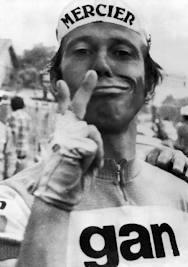 During his 11 year career, Barry Hoban won eight stages of the Tour de France and this record for a British rider was held until Mark Cavendish surpassed it in 2009. Hoban’s first stage win came on stage 14 of the 1967 Tour de France and should have been a celebration of a new force in British cycling. Instead, it was as an emotionally charged win as a result of the tragic death of his Great Britain team mate, Tom Simpson on the slopes of Mount Ventoux. Simpson collapsed on the ascent of the Giant of Provence and, despite the efforts of Dr Dumas, he died where he fell, 3 km from the summit.
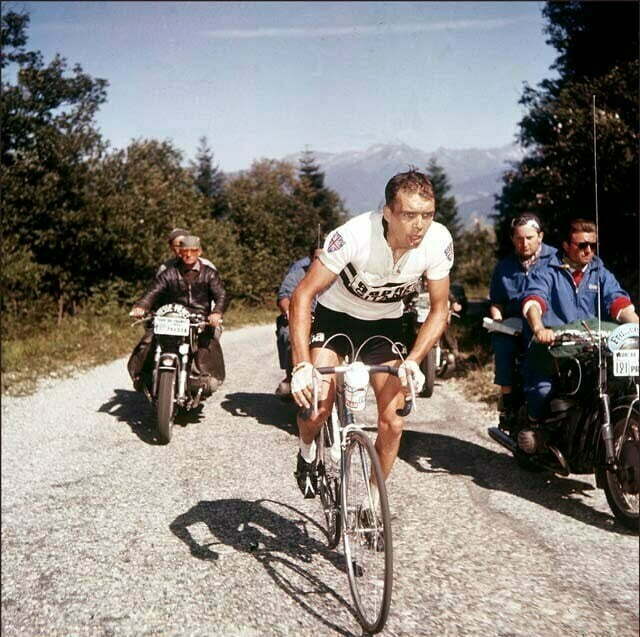 Brian Robinson’s first stage win in the Tour de France was a triumph for road cyclists in Britain. In the late 19th century the National Cyclists Union (NCU) had banned road racing in theUK and it took the concerted efforts of many, including Percy Stallard, to encourage regional groups of clubs to affiliate to the newly formed British League of Racing Cyclists (BLRC). Under the BLRC, these clubs started organising road races against the wishes of the NCU and a bitter feud began that was to last for many years. Under this schism the NCU was asked to send a British team to the 1955 Tour de France and this team featured Brian Robinson, who had already been prominent in other Continental European road races. It was a tough race for all, and Brian Robinson and Tony Hoar were the only British riders to complete it.